

Cannon explains that viruses, in general, are very susceptible to heat.
“Viruses come ‘shrink-wrapped’ in a layer of fat that helps them to survive in our bodies by acting as a type of stealthy covering,” she says.
Spikes on the outside of this fat layer allow it to latch onto and enter your body’s cells. But this layer of fat is quite fragile and can easily be broken down by high temperatures.
“You can think of it as being melted, if you like, by high temperatures,” Cannon says. “And once that happens, the virus particle is no longer intact and can no longer infect anything.”
But how high does the temperature need to be? Many common household germs begin to die at temperatures above 160° F, says Alexandra Seguin, MSN, lead infection preventionist at the Rush University Medical Center in Chicago. And most germs will be completely eliminated at temperatures between 175° F and 212° F if those temperatures are sustained for a sufficient period.
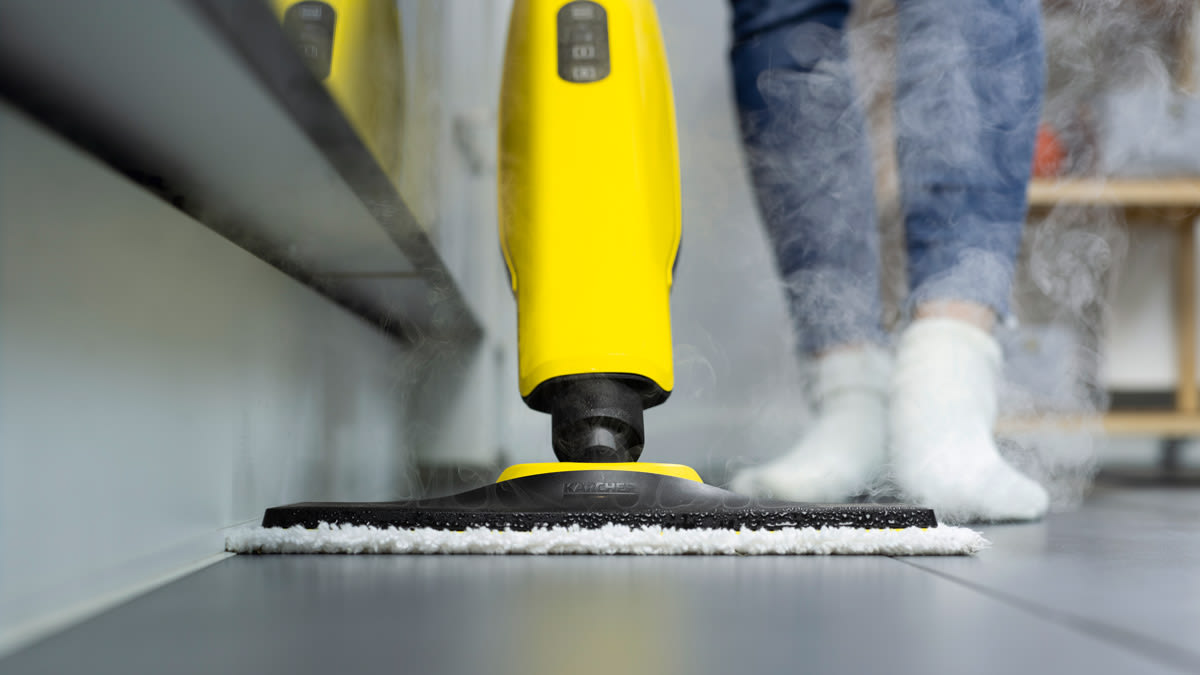
So while steam mops can reach those temperatures, you’d have to hold the mop in place for it to be effective against viruses. The time required to do this varies based on the temperature, the surface, and the type of virus, but you should be able to eliminate most household germs if a steam mop is pressed against the floor for several minutes at a high enough temperature, Seguin says. (This can be especially difficult to accomplish with steam mops that require you to manually pump them to generate steam, which can cause the temperature to fluctuate.) Seguin suggests that consumers refer to the mop manufacturer’s instructions for use, which should provide detailed information on the minimum temperature and contact time required to eliminate microorganisms.
But there’s another catch: Steaming your floor for minutes at a time may kill pathogens—but may also damage your floor.
While many manufacturers say that their steam mops can be used on various hard floors, including sealed wood, you might want to think twice about that. The National Wood Flooring Association, for instance, warns against using wet mops or steam mops on wood floors because they can damage the finish and the wood flooring itself over time. It’s generally safer to use a steam mop only on ceramic and porcelain tiles. Regardless of the flooring material, if your flooring is still under warranty, check with the manufacturer to make sure that using a steam mop won’t void it.
Instead of using a steam mop to disinfect your floors, consider using an EPA-registered disinfecting product or a diluted bleach solution. You’ll need to leave the disinfectant on the surface long enough to effectively kill the germs. You can find the contact time in the usage directions of your disinfectant. Also make sure the product is recommended for use on the type of flooring you have. Remember, too, that simply cleaning with soap and water removes most harmful viruses and bacteria from surfaces, according to the Centers for Disease Control and Prevention.