



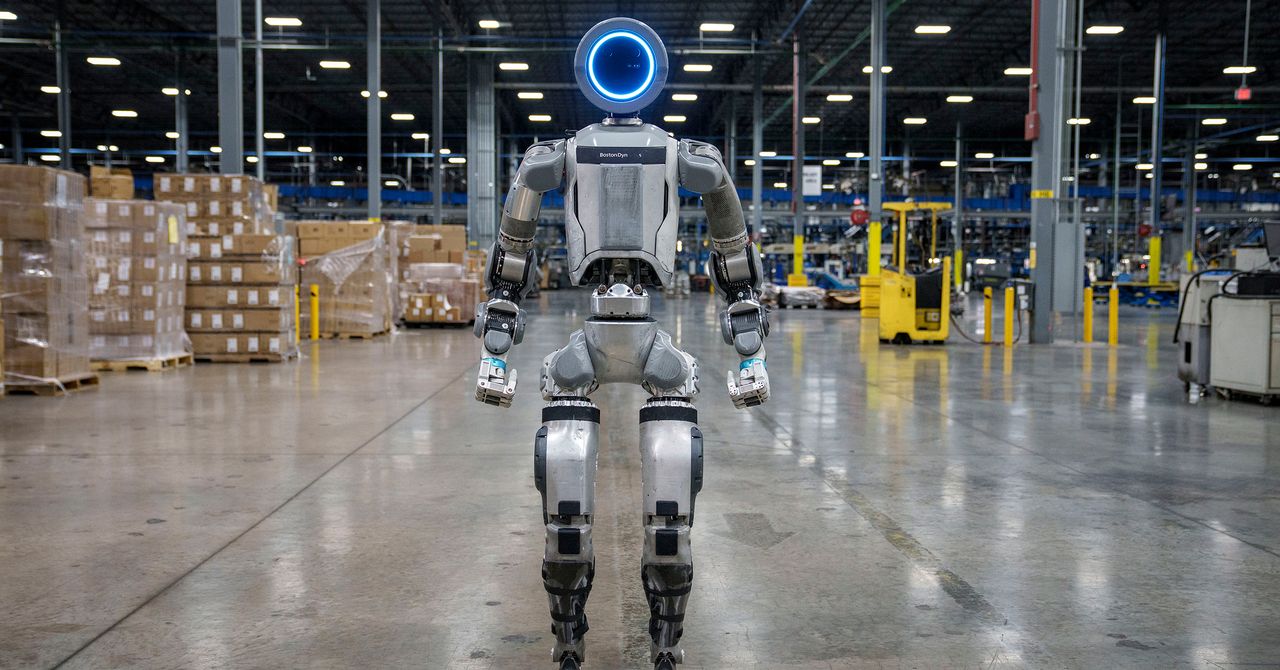
Atlas can already dance and perform acrobatics but, like other humanoids, lacks the intelligence needed to understand its environment, make complex decisions, and manipulate unfamiliar objects with its hands. That could start to change with the addition of an advanced AI model like Gemini, though it’s unclear how robots will match the adaptability and subtlety of human manual dexterity.
“The real value going forward is for our robots to be contextually aware of their environment and able to use their hands to manipulate any object,” Robert Playter, CEO of Boston Dynamics, told WIRED ahead of today’s announcement. “And we think manufacturing environments, like in Hyundai factories, are a perfect place to deploy that today.”
For several decades, Boston Dynamics has pioneered the development of advanced robots, including humanoids and four-legged systems tested by the military as a way to carry supplies over rough terrain. The company was sold to Google in 2013 and was bought by SoftBank in 2017. In 2021, Hyundai acquired a controlling stake.
In recent years, advancements in motors, batteries, sensors, and other components have made it easier for startups and other companies to compete in the robotics space. More than a dozen firms in the US, including Agility Robotics, Figure AI, Apptronik, 1X, and Tesla, are working on humanoid systems. Overseas, the competition is even fiercer, as roughly 200 Chinese firms are developing humanoid systems, according to CMRA, a Chinese industry association.
Many AI firms are turning their attention to robotics, believing that AI models need a deeper understanding of the physical world to achieve humanlike intelligence. OpenAI is said to be developing humanoids. Tesla has shown off a humanoid called Optimus. Several startups are also working on models designed to let robots quickly master various physical tasks. Some hope to deploy humanlike robots as home helpers, despite their current limitations.