
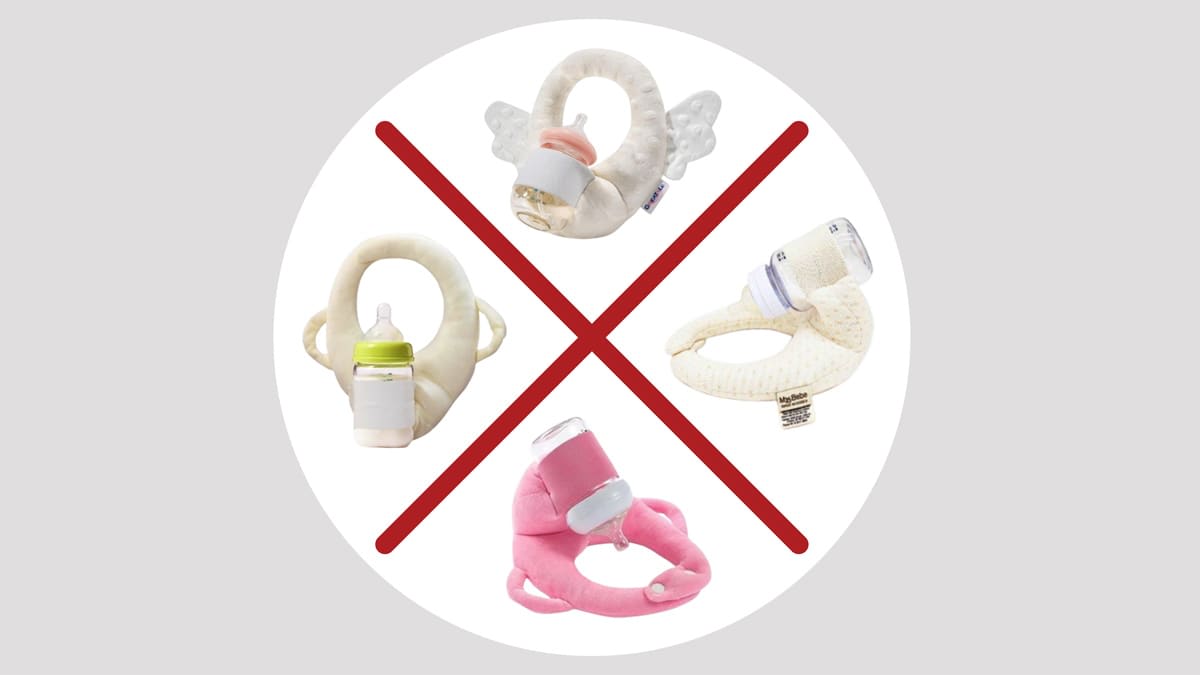
Self-feeding pillows also prevent infants from disengaging and removing themselves from danger. “The self-feeding pillows secure the bottle at an unsafe angle while keeping it fixed in place, preventing the infant from pulling or moving the bottle away,” says Ashita Kapoor, associate director of product safety at Consumer Reports.
Many designs also fasten around the baby’s neck or head. “The combination of neck restraints and fixed bottle positioning creates a dangerous situation where infants cannot turn their heads away or release themselves,” Kapoor says.
Another concern: Infant feeding pillows are designed for babies to feed while reclined or lying down, without a caregiver holding the bottle. Medical professionals universally recommend holding babies during feedings and keeping them semi-upright—never flat on their backs. If a baby begins to choke, gag, or cough while using an infant self-feeding pillow on their own, they’re even less able to stop the feeding if they’re lying down.
“Designing a product that encourages feeding while a baby is on their back is in direct conflict with safe bottle-feeding practices,” says Oriene Shin, manager of safety advocacy at Consumer Reports.
There’s also a risk that the pillow itself could shift and obstruct breathing because these products are made of plush materials that sit close to the face. “Soft, pillowy material near a baby’s face increases the risk of suffocation, especially when straps or fasteners make it difficult for a baby to move away,” Shin says.
Despite the risks, self-feeding pillows keep showing up in shopping carts for a simple reason: Many parents are bone-tired.
“Let’s face it, feeding a baby is time-consuming,” Brown says. “Babies need to eat every 2 to 3 hours, and each feeding may last 30 minutes or so.”
This provides an opportunity for brands to take advantage and seemingly “fill a need.” The problem, of course, is that these products provide the illusion of safety when infant self-feeding pillows are anything but. “Any product advertising that allows a baby to feed themselves is a red flag,” Shin says. “These products are marketed to exhausted parents and ultimately put babies at risk of serious injury or even death.”