


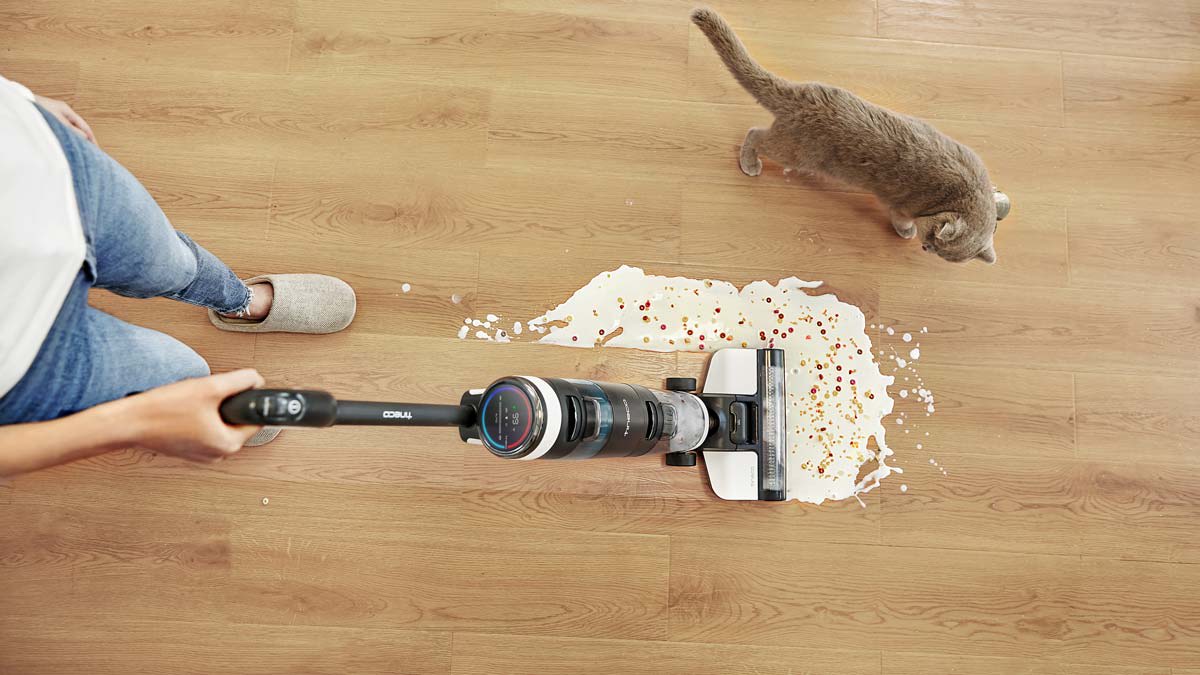
They’re Only for Hard Floors
Don’t mistake a combo vacuum-mop with a dedicated carpet cleaner. In fact, they can’t be used on carpet at all. While vacuum mops do suck up some of the liquid they dispense, the suction power isn’t sufficient to remove all the liquid from the carpet, often leaving it wet. And because they distribute liquid as they work, their vacuuming capability is limited to hard floors, such as wood, tile, laminate, and vinyl. Be cautious when using one on hardwood, as excessive water can damage a wood floor.
They’re Great at Wiping Up Pesky Stains
In addition to cleaning up messes (on hard floors) that a vacuum alone can’t handle, one reason you may want a wet mop is to remove stains. To determine how effectively these models remove what you leave behind, we applied three tough stains (hot sauce, espresso with milk, and baby food) to ceramic tiles, left them to dry overnight, and cleaned them with combo vacuum-mops the next day. Overall, the combo vac-mops did very well. Hot sauce was the toughest stain to erase, followed by the baby food (puréed peas). Coffee was the easiest.
They’re Expensive
The combo vacuum mops in our ratings range from just under $200 to $450, with the pricier ones tending to perform better in our tests. For comparison, you can get one of our recommended steam mops, like the Kenmore S200 Series SM2060, for as little as $80 and buy a top-notch upright vacuum, like the bagged Kenmore Intuition BU4022 or the bagless Shark Navigator Professional NV360, for less than $200 more.
Special Cleaning Solutions Cost Extra
While you can use plain water in any of the combo vac-mops in our tests, some also offer the option of using a detergent specified by—and available from—the manufacturer at a cost comparable to other common cleaning solutions.
These Cleaners Are a Mess to Clean
Squeezing out a cloth or sponge mop can be messy, and so can cleaning most combo vac-mops. While many have self-cleaning cycles, those still require you to empty the dirty-water tank after wiping the floor and before running the self-cleaning cycle. Then you have to empty the dirty-water tank again after running the self-cleaning cycle. You also have to routinely clean the brushroll and the filter for the dirty-water tank.
And there’s one more yucky chore you shouldn’t ignore. From time to time, you should clean out the tube that connects the brushroll to the dirty-water tank. Some models come with a cleaning brush for this purpose, but for others, you’ll have to improvise or use your fingers to remove the debris.
Keep in mind that you need to let all of the parts dry completely before reassembling the appliance. And some manufacturers recommend replacing the brushroll every six months.