


That’s a lot of complaints, I know. But if you just need something simple and “good enough,” the Logitech Brio 300 will do and certainly has better lowlight performance over an older option like the Logitech C920. If you have decent lighting in your room, the Brio 300 will still be an upgrade over your laptop’s webcam in terms of image quality.
The gap between the $150 and $50 is pretty wide, but honestly, there aren’t a lot of great options in between that I’ve tested. Check in my honorable mentions down below for some other options in between, but truthfully, I haven’t yet seen a $100 webcam that actually feels like it’s worth the extra money. One I’m looking forward to testing in my next round is the Anker AnkerWerk C310, the 4K upgrade over the C200 from a few years ago. It comes in right at $100 and has a larger 1/2.5-inch sensor.
Best PTZ Webcam
PTZ, also known as Pan-Tilt-Zoom webcams, are the latest hotness in the world of home office cameras. As the name suggests, these are far more versatile than a standard webcam. Essentially, that the camera sits on a gimbal and can follow you around a room using face-tracking. They can pan far to the left or right, tilt up and down, and use a digital zoom. That’s a pretty advanced feature set, and likely not the kind of thing most people shopping for a webcam really need. But if you happen to use your webcam for streaming, giving presentations, teaching courses, or really anything else that involves staying on camera while moving about your room, you probably need one. Even if you don’t need one, you’ll probably get a kick out of just experimenting with all they can do.
Courtesy of Amazon
Obsbot
Tiny 3
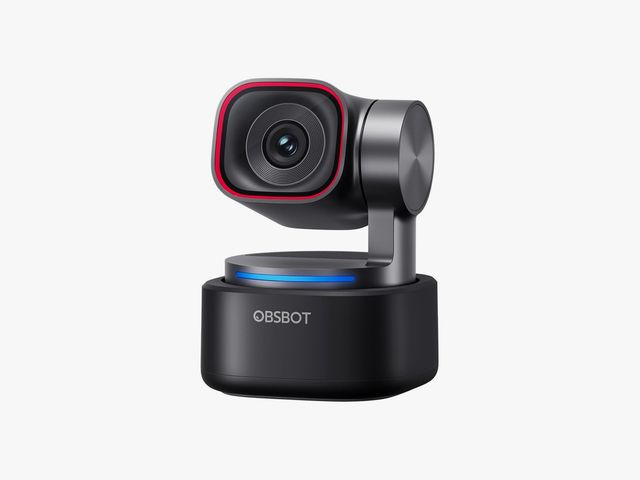
There are a couple of good options, but the best is the Obsbot Tiny 3 ($349). That’s too bad, as it’s also the most expensive webcam I tested at $349. That’s likely more than most people want to spend on a webcam, but it did produce the overall best color accuracy. This camera replicated real-life color without looking overprocessed, better than any other webcam I tested—even beyond what the Insta360 cameras can do. I still prefer the lowlight performance of the Insta360 cameras, but the Obsbot Tiny 3’s colors are more natural. It can even shoot in 120 frame per second in 1080p, though I’m not sure quite what the use case is for that.
Obsbot has a cheaper version as well, the Obsbot Tiny 3 Lite ($179), which very well may be the PTZ webcam that most people should buy due to the lower price. It’s a minor step down in image quality, as it uses a small camera sensor. Most notably, you don’t get as much of that natural background blur and the lowlight performance isn’t as strong. But it’s one of the most affordable ways to get the PTZ features without too much of a downgrade in quality. And really, it’s those PTZ features that you buy these cameras for anyway.
In its latest release, Obsbot has introduced lots of interesting new ways to control the gimbal using AI. It can track objects, follow your voice, and gives you a few audio modes that would be helpful in specific use cases. For example, one might. There’s even a feature that allows you to use preset voice commands to control the gimbal, such as choosing between preset angles or zooming in. All of the previous software features are still around too, which are too extensive to list here, but include setting up customizable preset angles, desk mode, multiple speeds of head tracking, and so much more. There’s ton to play around with, which is what makes these PTZ camera so fun.
If you do like the design of the Insta360, though, the company has a PTZ version of the Link 2C Pro that I recommended above. The Insta360 Link 2 Pro ($250) has the exact same picture and microphone quality, with the additional features of being able to pan, tilt, and zoom. (There’s also a cheaper model, the Insta360 Link 2 ($200).) The main benefit it has over the Obsbot Tiny 3 is that it’s a full $100 cheaper. That’s significant, even if the color accuracy isn’t quite as good. For what it’s worth, I preferred the way it handled the lowlight scenarios slightly better than the Obsbot Tiny 3. The Tiny 3 was definitely overexposed right out of the box.
Though the Insta360 Link 2 Pro is not quite as full-featured as the Obsbot cameras in terms of AI trickery, I do like that you can control the gimbal using your phone to make adjustments. Instead of having to rely solely on the desktop software or voice commands, the Insta360 cameras let you quickly pull up controls in a browser on your phone after scanning the QR code, which is super handy.